Best Beginner Telescope 2026: 3 Honest Picks for First-Time Buyers
Orion Telescopes shut down in 2025, so half the 'best telescope' guides online are stale. Here's a fresh take on the three telescopes worth buying as a beginner in 2026 — including the one that lets your phone do the hardest part for you.
HobbyStack may earn a commission from links on this page at no extra cost to you. Our picks are chosen on merit; the commission helps fund the research.
- Orion Telescopes shut down in 2025. If you see them recommended in old buying guides, those guides are out of date. The 2026 beginner market is Celestron and Sky-Watcher.
- Our pick: the Celestron StarSense Explorer LT 114AZ (~$250). Uses your phone's camera to show you exactly where to push the telescope to find things — solves the single hardest problem in amateur astronomy (finding objects in the sky).
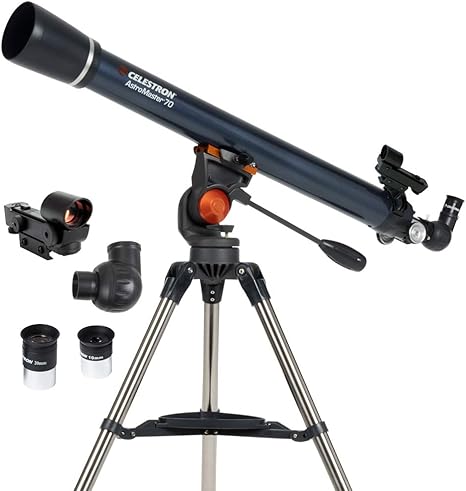
- Budget pick: the Celestron AstroMaster 70AZ (~$180). Simpler 70mm refractor, no smart features — point, look, see the moon and Jupiter's moons. Great if you'll mostly stargaze from a fixed backyard spot.
- Aperture pick: the Sky-Watcher Heritage 130P (~$320). The most light-gathering area per dollar in the beginner category, on a clever collapsible tabletop Dobsonian mount. Best for someone willing to learn the sky themselves rather than rely on phone guidance.
- Skip anything sub-$100 from a brand you've never heard of. Cheap telescopes have wobbly mounts that make the image shake unusably with every breath. You'll see less through a $50 telescope than with the naked eye.


What actually matters in a beginner telescope
Every "best telescope" article opens with magnification, and every experienced astronomer winces. Magnification is the least important spec. What matters, in order:
Aperture — the diameter of the main lens or mirror. This determines how much light the telescope gathers, which determines what you can actually see. A 114mm aperture sees roughly 2.5x more sky objects than a 70mm. A 130mm sees more than that.
Mount stability — the tripod or base the telescope sits on. A great telescope on a wobbly mount is useless because the image shakes with every touch and every breath of wind. A mediocre telescope on a stable mount is enjoyable. Most cheap "beginner telescopes" fail here.
Finder system — how you point the telescope at things. Manual finder scopes work but require you to learn the sky. Smartphone-guided systems (Celestron's StarSense, Vaonis, Unistellar) use your phone's camera to show you where to push the telescope. This is the biggest beginner-market shift of the last few years and the reason the StarSense Explorer LT 114AZ is our top pick.
Optical type — refractor (uses a front lens), reflector (uses a curved mirror), or compound (uses both). Refractors are simpler and better for moon/planets; reflectors give more aperture for the same dollar and are better for galaxies and nebulae. For beginners, the optical type matters less than the mount and finder.
What does NOT matter much: magnification (you compute this via the eyepiece, you'll usually want low magnification for most objects), "GoTo" computerized mounts (great later, overkill for a first telescope), brand name beyond the major three (Celestron, Sky-Watcher, and Meade still operate).
How we picked
We weighted picks against three real beginner concerns:
- Finding things in the sky: this is the #1 frustration for new astronomers. Star charts work but require learning. Smartphone-guided systems remove the learning curve.
- Stability: a $100 mount under a $400 optical tube is a $500 frustration. The picks here all have mounts that match the optical quality.
- Portability: most beginners don't have a permanent observatory pad. The telescope needs to set up and break down in under 10 minutes for it to actually get used.
- What you'll see in the first month: the moon (any of these), Jupiter's bands and Galilean moons (any of these), Saturn's rings (all of these), the Orion Nebula (the 114mm and 130mm), Andromeda Galaxy (best with the 130mm).
What we don't recommend: any telescope under $100 (always cheap mount, always disappointing), department-store "magnification" telescopes (Tasco, etc — wrong priorities), motorized GoTo mounts as a first purchase (overkill, expensive, finicky setup).
 Best for most beginners
Celestron StarSense Explorer LT 114AZ
$230The single biggest beginner-frustration in amateur astronomy is finding objects in the sky. The StarSense Explorer solves this elegantly: dock your phone in the included cradle, point the telescope roughly skyward, and the app shows you arrows for exactly which direction to push to land on your target. It works because the phone's camera plate-solves the star pattern in real time. The 114mm reflector itself is fully capable — moon, planets, Orion Nebula, brighter galaxies and star clusters all visible. Mount is a sturdy alt-az that holds steady when you nudge the scope.
What's good
- StarSense smartphone-guided pointing — eliminates the hardest part of finding objects
- 114mm reflector gathers ~2.5x more light than the 70mm budget pick
- Stable alt-azimuth mount that holds position
- Setup and breakdown in under 10 minutes — no permanent observatory needed
- Celestron's app is well-maintained and updated regularly
What's not
- StarSense requires a smartphone (works with iPhone 7+ and most Android since 2018)
- Reflector tubes need occasional collimation (mirror alignment) — 5-min job once you know it
- Less portable than the smaller refractors — bigger box, heavier mount
 Best under $200
Celestron AstroMaster 70AZ
$160If your budget is firm under $200, the AstroMaster 70AZ is the cleanest pick. 70mm refractor on a simple alt-azimuth mount — no smart features, no collimation, no computer. Point it at the moon and you'll see the craters; point it at Jupiter and you'll see four moons; point it at Saturn and you'll see the rings. Great for someone who wants a fixed backyard stargazing setup without the iPhone-required workflow of the StarSense models. Real Celestron build quality at the price.
What's good
- Genuinely affordable working telescope under $200
- Refractor design — no collimation, no maintenance, just look
- Celestron build quality (mount is real, not toy)
- Best for solar-system objects: moon, planets, brighter stars
What's not
- 70mm aperture limits deep-sky views — galaxies and nebulae look faint
- Manual finder requires learning the sky or using a separate star-chart app
- Mount is solid but not as steady as the larger picks
- No upgrade path — you outgrow it rather than upgrade pieces
 Most aperture per dollar
Sky-Watcher Heritage 130P Flextube
$355The Heritage 130P is widely respected in amateur astronomy forums as the best aperture-per-dollar pick in the beginner category. 130mm Newtonian reflector — more light-gathering area than either Celestron pick — on a clever collapsible tabletop Dobsonian mount that breaks down to a much smaller box for storage and transport. No smart features; you find things by learning the sky. That's a feature if you want to actually develop the skill rather than rely on a phone, and a drawback if you want plug-and-play. For deep-sky objects (galaxies, nebulae, distant star clusters) this is meaningfully better than the smaller telescopes at similar prices.
What's good
- 130mm aperture — most light-gathering in the beginner category
- Best for deep-sky objects (Andromeda, Orion Nebula, distant star clusters)
- Collapsible Flextube design stores small for apartment-dwellers
- Sky-Watcher's reputation for honest specs and lasting build
- Forces you to learn the sky — a real skill that compounds over years
What's not
- No smartphone guidance — finding objects takes practice
- Tabletop mount needs a sturdy table or stool at the right height
- Newtonian reflector requires occasional collimation
- More expensive than the StarSense for someone who would value the phone guidance
Light pollution is the silent killer of new-telescope joy. Even a great 130mm reflector under a bright city sky shows you a faded version of what it shows under dark skies. Before you buy, check your sky on lightpollutionmap.info — if you're in Bortle 7+ skies (most cities), plan a once-a-month drive to Bortle 4 or darker (~30–60 min outside most US cities) for the real deep-sky views. Or commit to mostly observing the moon and bright planets, where light pollution barely matters.
What you'll see in your first month
Set realistic expectations and you'll love the hobby; expect Hubble photos and you'll quit by week three.
Anything in this list, all picks: the moon (craters in detail), Jupiter and its 4 brightest moons, Saturn and its rings, Venus phases, Mars (small disc with surface markings only at oppositions), the Orion Nebula (M42, fuzzy green-blue glow), the Pleiades star cluster (M45).
The 114mm StarSense and 130mm Heritage: the Andromeda Galaxy (M31, hazy oval — meaningfully visible only in the 130mm), brighter globular clusters like M13, the Ring Nebula in Lyra (small, faint), open star clusters across Cassiopeia and the winter sky.
The 130mm under dark skies: more galaxies (M81, M82, M51), more nebulae, double stars revealed in pairs.
What none of them will show you: the brilliantly colored Hubble images you've seen online. Those come from hours of exposure on dedicated cameras. What you'll see through the eyepiece is monochromatic and softer — but the moment Saturn's rings resolve through your own scope is the moment you understand why this hobby exists.
Before you buy
Check your skies. Look up your Bortle scale rating on lightpollutionmap.info. Below Bortle 5 you can see deep-sky objects from home; above Bortle 6 you mostly need a dark-sky drive for galaxies and nebulae.
Plan to spend on eyepieces eventually. The eyepieces a beginner telescope ships with are workable but not great. A $50 wide-field eyepiece is the single best upgrade for any of these scopes after the first month.
Don't expect to use it every night. Realistic cadence is 1–3 sessions a week when weather and moon phase cooperate. Plan storage that doesn't require setting up from scratch.
Skip the dew shield until you've used it once outside. You'll learn fast whether your local conditions need one.
Get a red flashlight. Even a $10 one. White flashlights destroy your dark-adapted vision for 20+ minutes; red light preserves it.
Common questions about beginner telescopes
What ever happened to Orion Telescopes?
Should I buy a refractor or reflector for my first telescope?
Do I need a "computerized GoTo" telescope?
What is "aperture" and why does it matter more than magnification?
Can I see Hubble-style photos through these?
How dark do my skies need to be?
For most people, the Celestron StarSense Explorer LT 114AZ is the buy — the best balance of price, quality, and longevity. Want to spend less? The Celestron AstroMaster 70AZ gets you started for a fraction of the cost. Ready to go deeper? The Sky-Watcher Heritage 130P Flextube is the upgrade.
The HobbyStack editorial team researches each guide using practitioner communities, published resources, and direct input from active hobbyists. Every guide is reviewed for accuracy before publication and updated when practices change.
About our editorial process →More gear guides

Best Beginner Binoculars 2026: Celestron Nature DX vs Nikon Monarch M5 vs Vortex Viper HD
Binoculars are the one purchase every birder makes — get this right and you'll use the same pair for 20 years. 8x42 is the sweet spot; here are the three pairs worth buying as a beginner.
Best Beginner Mirrorless Camera 2026: Canon EOS R50 vs Sony ZV-E10 II
The best beginner mirrorless camera teaches you photography, not menus. It needs reliable autofocus, a grip that makes sense, and enough image quality to reward good technique. The Canon EOS R50 with its kit lens is the right camera for most people who are just starting out. Here's why — and who should buy something different.
Best Beginner Hiking Boots 2026: Merrell Moab 3 vs Salomon X Ultra 4
Your first hiking boots need to do three things: not blister you, stay dry on wet trails, and grip technical terrain. The Merrell Moab 3 Waterproof checks all three for around $130. Here are three real boots — a non-waterproof breathable option, the waterproof all-rounder, and a stiffer upgrade for rocky terrain — each with a confirmed Amazon link.
Best Mountain Bike Knee Pads for Beginners
Once your trails get real features, knee pads are the highest-value protection you can add — knees hit the ground and the bike most often. Modern flexible pads are comfortable enough to forget you’re wearing them. Here are three, how we chose them, and what to expect.
Best Hydration Packs for Mountain Biking
Once rides get longer than a quick loop, you need water you can drink without stopping — plus room for a spare tube, tools, and a snack. A hydration pack carries it all hands-free. Here are three, how we chose them, and what to expect.
Best Mountain Bike Gloves for Beginners
Gloves are the cheapest, most useful thing to add after a helmet: better grip, less vibration, and saved skin when (not if) you go down. Full-finger, always, for trail riding. Here are three worth pulling on, how we chose them, and what to expect.