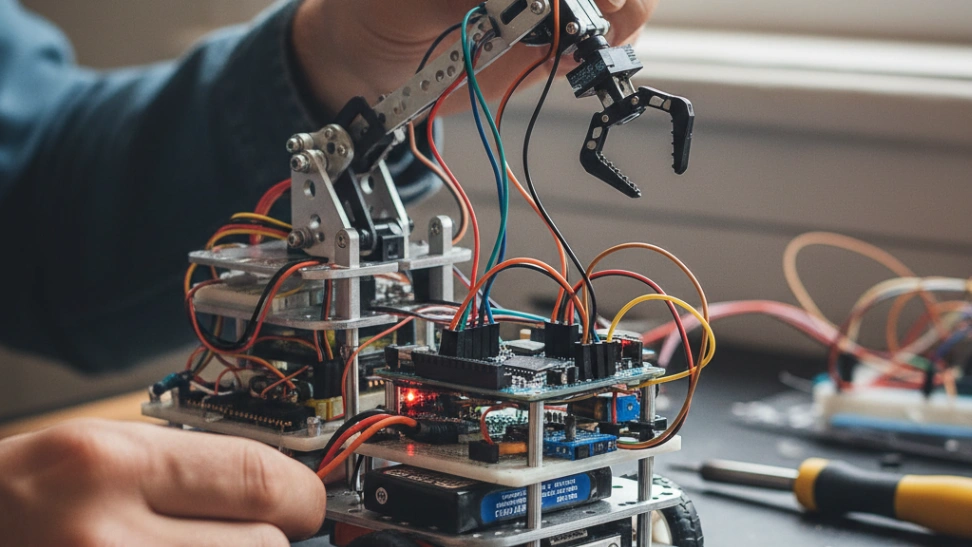
Amateur robotics is the hands-on pursuit of designing, constructing, and programming robots. It bridges the gap between theoretical engineering and tangible creation, allowing enthusiasts to bring their mechanical and electronic visions to life. This hobby demands a blend of mechanical aptitude, electrical knowledge, and programming skills. Whether building a simple line-following robot, a complex robotic arm, or even a walking automaton, the process involves problem-solving, iterative design, and a deep dive into components like motors, sensors, microcontrollers, and power systems. It’s about understanding how parts work together, troubleshooting when they don’t, and the immense satisfaction of seeing a machine you built perform a task autonomously.
For the tinkerer who thrives on solving complex problems and enjoys building functional, interactive machines.
Your journey starts here. Follow these steps to get started with Amateur Robotics.
Purchase a reputable Arduino starter kit, such as the Arduino Official Starter Kit or Elegoo's UNO Project Super Starter Kit. These kits provide a microcontroller board, essential electronic components (LEDs, resistors, sensors), and a project guide. For the official kit, begin with their introductory tutorial on basic circuits and programming: https://docs.arduino.cc/learn/kits/starter-kit.
Understand fundamental electronic concepts like Ohm's Law (voltage, current, resistance), basic circuit diagrams, and how components like LEDs, resistors, and capacitors function. Resources like SparkFun's Learn section offer excellent beginner-friendly tutorials.
Familiarize yourself with the Arduino IDE and the C/C++ based language used for programming. Start with simple 'blink' programs and gradually move to reading sensor data and controlling actuators. Official Arduino documentation and numerous online tutorials are invaluable.
Assemble your first robot, perhaps a simple obstacle-avoiding robot using ultrasonic sensors and DC motors. Many kits include these components, or you can find comprehensive guides online from Adafruit or Instructables.
Our top picks for core tools to get you started.
Recommended items to enhance your experience.
As an Amazon Associate, HobbyStack may earn from qualifying purchases. Prices are estimates.
Robots can have dozens of wires. Mismatched connections or poor soldering are common causes of failure and can be time-consuming to diagnose.
Underpowering motors or using the wrong battery can lead to erratic behavior or complete failure. Always check the power specifications for your components.
Trying to build a humanoid robot as your first project is likely to lead to frustration. Start small and build complexity gradually.
A hobby's core characteristics, based on community votes.
35% Solo
You tend to prefer your own company but are open to occasional, low-pressure social activities.
30% Energetic
You prefer engaging activities that keep you active and on your feet.
70% Indoors
You prefer hobbies enjoyed in the comfort of your own home or a dedicated indoor space.
51% Creative
You are a highly creative and expressive person, drawn to imagination and artistry.
30% Mental
You tend to prefer intellectual challenges but enjoy hobbies with some light physical activity.
Based on 35 total trait votes.
If you like Amateur Robotics, you might also enjoy these related hobbies.
Dive deeper with these community-recommended websites, guides, and forums.
The official hub for Arduino boards, software, and documentation, essential for beginners.
A vast repository of DIY projects, including many amateur robotics guides with step-by-step instructions.
Excellent tutorials and project guides covering electronics, microcontrollers, and robotics from a leading electronics retailer.
A small computer on a single integrated circuit containing a processor core, memory, and programmable input/output peripherals.
A component responsible for moving or controlling a mechanism or system; commonly motors in robotics.
A device that detects and responds to some type of input from the physical environment, such as light or heat.
A circuit used to control the speed of an electric motor and its direction.
This hobby's profile is shaped by the community. See what's most popular and cast your own vote to refine its identity.
The community strongly defines Amateur Robotics by aspects of the Technology & Engineering category.
Many users also associate Amateur Robotics with Crafts & Making.
A number of users see a connection between this hobby and Science & Exploration.
A number of users see a connection between this hobby and Digital & Screen Entertainment.
Amateur robotics is the hands-on pursuit of designing, constructing, and programming robots. It bridges the gap between theoretical engineering and tangible creation, allowing enthusiasts to bring their mechanical and electronic visions to life. This hobby demands a blend of mechanical aptitude, electrical knowledge, and programming skills. Whether building a simple line-following robot, a complex robotic arm, or even a walking automaton, the process involves problem-solving, iterative design, and a deep dive into components like motors, sensors, microcontrollers, and power systems. It’s about understanding how parts work together, troubleshooting when they don’t, and the immense satisfaction of seeing a machine you built perform a task autonomously.
For the tinkerer who thrives on solving complex problems and enjoys building functional, interactive machines.
Your journey starts here. Follow these steps to get started with Amateur Robotics.
Purchase a reputable Arduino starter kit, such as the Arduino Official Starter Kit or Elegoo's UNO Project Super Starter Kit. These kits provide a microcontroller board, essential electronic components (LEDs, resistors, sensors), and a project guide. For the official kit, begin with their introductory tutorial on basic circuits and programming: https://docs.arduino.cc/learn/kits/starter-kit.
Understand fundamental electronic concepts like Ohm's Law (voltage, current, resistance), basic circuit diagrams, and how components like LEDs, resistors, and capacitors function. Resources like SparkFun's Learn section offer excellent beginner-friendly tutorials.
Familiarize yourself with the Arduino IDE and the C/C++ based language used for programming. Start with simple 'blink' programs and gradually move to reading sensor data and controlling actuators. Official Arduino documentation and numerous online tutorials are invaluable.
Assemble your first robot, perhaps a simple obstacle-avoiding robot using ultrasonic sensors and DC motors. Many kits include these components, or you can find comprehensive guides online from Adafruit or Instructables.
Our top picks for core tools to get you started.
Recommended items to enhance your experience.
As an Amazon Associate, HobbyStack may earn from qualifying purchases. Prices are estimates.
Robots can have dozens of wires. Mismatched connections or poor soldering are common causes of failure and can be time-consuming to diagnose.
Underpowering motors or using the wrong battery can lead to erratic behavior or complete failure. Always check the power specifications for your components.
Trying to build a humanoid robot as your first project is likely to lead to frustration. Start small and build complexity gradually.
A hobby's core characteristics, based on community votes.
35% Solo
You tend to prefer your own company but are open to occasional, low-pressure social activities.
30% Energetic
You prefer engaging activities that keep you active and on your feet.
70% Indoors
You prefer hobbies enjoyed in the comfort of your own home or a dedicated indoor space.
51% Creative
You are a highly creative and expressive person, drawn to imagination and artistry.
30% Mental
You tend to prefer intellectual challenges but enjoy hobbies with some light physical activity.
Based on 35 total trait votes.
If you like Amateur Robotics, you might also enjoy these related hobbies.
Dive deeper with these community-recommended websites, guides, and forums.
The official hub for Arduino boards, software, and documentation, essential for beginners.
A vast repository of DIY projects, including many amateur robotics guides with step-by-step instructions.
Excellent tutorials and project guides covering electronics, microcontrollers, and robotics from a leading electronics retailer.
A small computer on a single integrated circuit containing a processor core, memory, and programmable input/output peripherals.
A component responsible for moving or controlling a mechanism or system; commonly motors in robotics.
A device that detects and responds to some type of input from the physical environment, such as light or heat.
A circuit used to control the speed of an electric motor and its direction.
This hobby's profile is shaped by the community. See what's most popular and cast your own vote to refine its identity.
The community strongly defines Amateur Robotics by aspects of the Technology & Engineering category.
Many users also associate Amateur Robotics with Crafts & Making.
A number of users see a connection between this hobby and Science & Exploration.
A number of users see a connection between this hobby and Digital & Screen Entertainment.